Growth is faster with fertilizer.
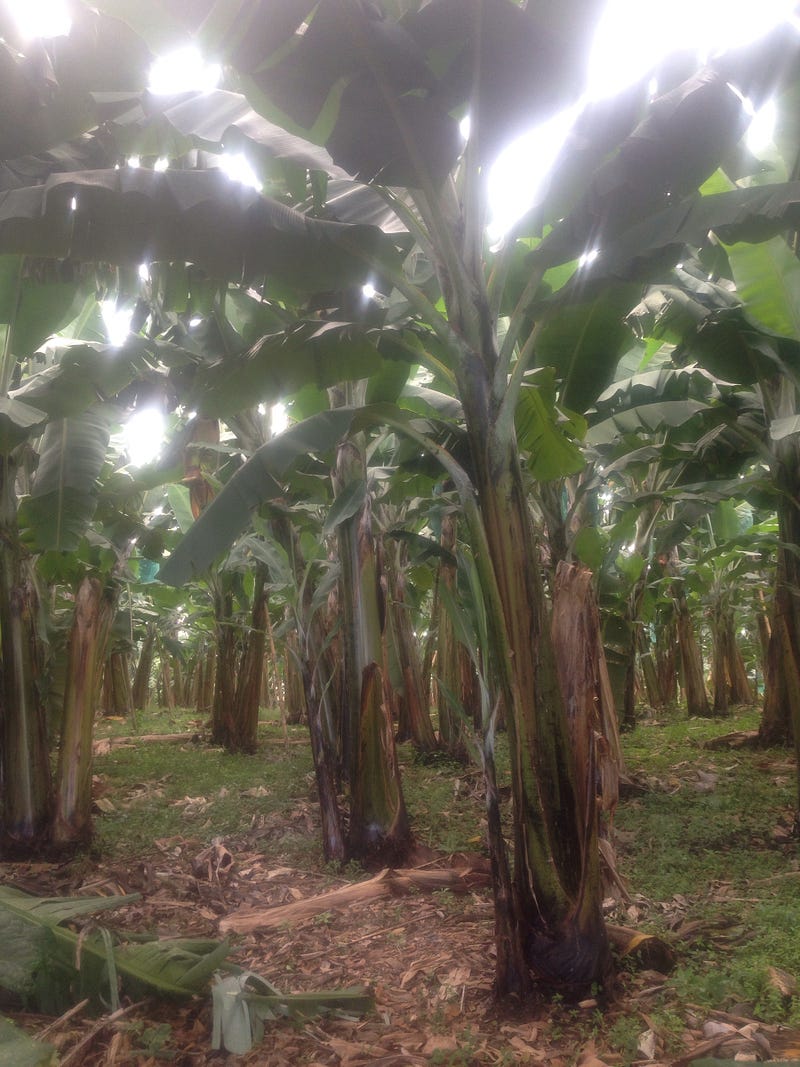
By one of the many, but probably more analogy prone Andrew Currie’s of this world.
Unless you wield a machete as a terrifying behaviour management tool, at first glance teaching and banana farming may not seem very similar. Also, if you’ve ever taken or observed one of my classes you are probably well aware that I love an analogy and this overthinker has had a bit of time to ponder in the last couple of days so let’s see what he’s come up with. Essentially, for the optimal growth of our students in every area of their development we need to fertilize their minds. But, there is more to this than spraying them with information. First, you need to ensure that they are ready to absorb the lesson (knowledge, skills and/or values) that you’ve taken the time and effort to prepare for them.
For the last 4 mornings I have been living and working on a “finca” in rural Colombia in exchange for a bed and two meals a day.
Why on earth would you take time out of your holiday to work?
Great question… it was a great deal for me. I had free Spanish practice during the mornings, ate some great food, hand washed my clothes whenever I felt the need and learned some things about farming which is a profession that is part of my family’s past. I even found time to explore this fantastic “Coffee triangle” region of Quindío on the back of 1950's jeeps while chatting with the locals.

However, during the muscular ache creating work section of my day, my mind has wandered and for whatever reason I have often wound up contemplating teaching, the occupation I’ve had since 2005.
My job here at the finca has been to prepare the bottom of banana plants so that they are ready to be fertilized. Without being too patronizing, fertilizer increases the rate of growth of plants which means that we can reap the rewards (Bananas = Money) of our farming faster. So, in a data driven education system our students would be the plants and their results would be the bananas or coffee beans.

Above is a banana plant, NOT a tree… get it right! At the bottom of the plant there are a lot of weeds. These are distractions from or obstacles to learning. They might include:
Lack of confidence;
Inability to see relevance;
Learning difficulties;
Behavioral issues;
Social/Family problems;
A teacher’s misunderstanding of a students current level/knowledge etc; or
Disinterest… just to name a few.
We could dump the fertilizer at the foot of this plant and hope that more of it goes to the plant than the weeds, but that is not the most effective way of getting results. We need to give the plant the best possible chance of growth. We need to ensure that the plant is ready to absorb the fertilizer and therefore we must clear these obstacles to the best of our ability.
My first hour was spent using my bare hands. This was not the most efficient method however I got the job done. Later, I was trusted with a machete.

In the beginning, I didn’t see the need for it as the plants I was attending to were easy enough to clear without it. But later, the plants I needed to attend to had more durable weeds surrounding them, spiders and ants that drew blood, so learning to use this tool was to my advantage in the long run.
This is where my colleague Jose came into play. He demonstrated an effective technique which I watched and tried to imitate. Later when I wasn’t sure, I asked him questions. It’s a good thing I could also observe his work to make sure that I was on the right track because I found it difficult to understand anything that came out of his mouth. I didn’t have the vocabulary and honestly I think he was probably speaking his own language at times (I think we’ve all been to a professional development session like this).

He was happy enough to teach me even though it wasn’t his thing however, he loved to work! He never took holidays, only the odd weekend when there was no work. What an absolute machine! Especially due to the fact that he rides his rickety bike up and down hills from a nearby town to get to and from work everyday!
The plants were there (ready to learn), I had the tools (technology, textbooks, learning spaces, specialized equipment, pedagogical techniques, collaborative colleagues, supportive management, parents and other stakeholders etc.) and an understanding of my goal (to stimulate the curiosity of my students, display the relevance of whatever I am teaching them and to build their confidence in their abilities to the point where learning can take place autonomously. With these things is place the fruit will look after itself), now it was time to make a real difference.
I hacked away at the bottom of those trees like a maniac. No rest! Those hours flew by and I could see the impact I was having.
But… the next day… I was stiff as a board! How was I going to continue?
Jose’s advice for me the next day was to take it a bit slower. Sharpen your machete and have a laugh with him while you take a rest every now and then. Stay hydrated. Maybe change up the scenery a bit (working on the slope is actually easier because you don’t have to bend over as much). Wear gloves. Keep refining your slashing technique. Stay out of the sun. Relax… just don’t kill the children of the plant!
I feel like all of these tips apply to teaching to decrease the likelihood of burnout.
But what about the children of the plant?
Good question… I’d call them a student’s curiosity, confidence and learning techniques. A curious student with the confidence and skills required to learn can take lessons from any situation. In this day and age, it is my opinion that this type of student is what we should be aiming to create and that’s not easy. That takes time. It’s a collaborative and very important effort that we are more than capable of achieving if we take care of ourselves and each other as a learning community.
One last thought.
In our results driven society it’s easy to get caught up in the fact that students are not “where they should be”. Often we forget how far a student has come and some of our data collection does not allow us to really see their growth. So maybe it’s up to you to look for those changes in each of your students because when you really search, you might find you’ve done a job that you should be proud of… like the one below :)

No comments:
Post a Comment